Skip to content
Casus Foederis

Diplomatic strategy · Europe 1815–1871

Your ally calls. Will you keep your word?

Twelve great powers, from the Congress of Vienna to 1871. Every promise you make is remembered.

Casus foederis

A dispatch from Vienna

France has attacked Austria. Under our treaty of alliance, Vienna calls on us to go to war against France.

Each answer has a price. The other courts are watching.

Honoured. Legitimacy +4 at once, Vienna’s trust +12, and war with France. Another +4 comes with a deed: an assault on French soil, or a front held. A word kept only on paper costs 5.

Refused. Legitimacy −10, Vienna’s trust −35. The alliance lapses, and Austria now holds a casus belli against us.

The game’s own base values. In play, every call states its exact price before you choose.

Also coming to iPhone and iPad.iPhone and iPad: coming soon. Until then, wishlist the computer edition.

Read on

The game in three sentences

Europe, 1815: the Congress of Vienna has redrawn the map, and you lead one of twelve great powers for the next half-century.

You sign alliances and answer their calls, take provinces and give them back, and call a congress when a war has gone far enough.

Grow too fast and Europe unites against you. To win, the courts must recognise what you hold.

What the courts remember

  1. The word

    An alliance is a promise. When your ally is attacked it calls on you, and Europe watches whether you come, and whether you fight once you are there.

  2. The coalition

    Your real opponent. Grow too fast and your neighbours unite: a blockade on your revenue, and no separate peace.

  3. Legitimacy

    Land alone is not enough. In 1871 what counts is whether Europe recognises your right to it.

  4. The congress

    Wars end at the table. Call a congress and pay its price: gold, claims given up, provinces returned.

A steam train crossing a bridge through rain and mist, painted in loose, bright strokes.
J. M. W. Turner, Rain, Steam and Speed — The Great Western Railway, 1844. National Gallery, London. Public domain.

The century, as it was

Fifty-six years from Vienna to Versailles: the railway and the telegraph, three waves of barricades, two nations made one.

  1. Vienna. The Final Act of the Congress.

  2. The world: Washington. The Monroe Doctrine.

  3. Paris, Brussels, Warsaw. Three revolutions in five months.

  4. The world: Nanking. The Opium War ends.

  5. Metternich falls. Barricades in Berlin.

  6. The world: Perry’s ships in Edo Bay.

  7. Sevastopol. The siege has run since autumn.

  8. The world: A cable across the Atlantic. A dispatch takes minutes, not ten days.

  9. The world: The Suez Canal opens.

  10. Versailles. The German Empire is proclaimed.

So it went once.

One game, from the first turn to the last

Austria, medium difficulty, played to the end by the game’s own autopilot. Nothing here is staged: the map is the game’s, and the lines in italics are from its screens.

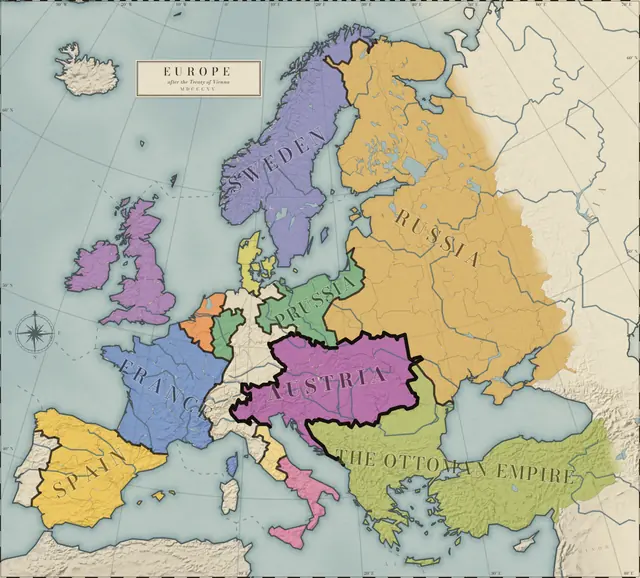
  1. 1815turn 1

    Vienna, autumn

    No court holds a casus belli against us. … From which side the first will come, no ambassador can say today.

    The chancellor’s first report. The map is as the congress left it.

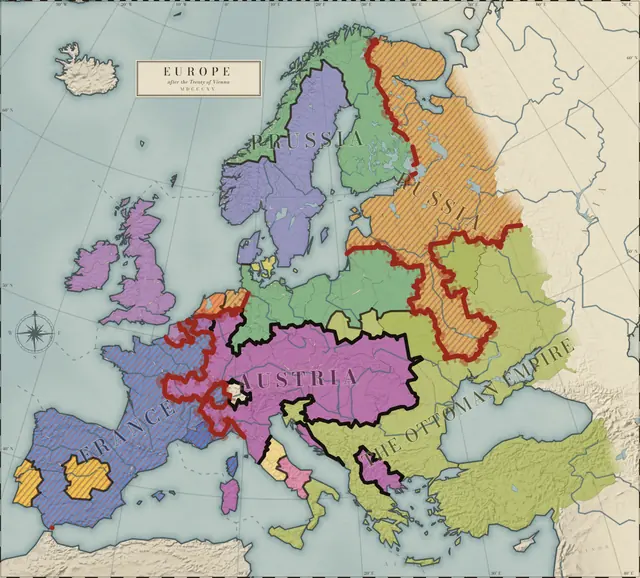
    Map of Europe in 1815, from this game: the territories of the twelve powers, wars hatched in the enemy’s colour.
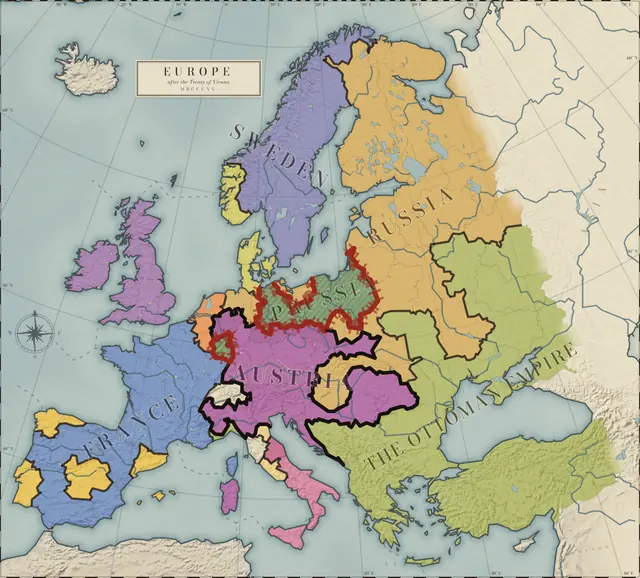
  2. 1829turn 27

    The scales

    Balance of power: threat 27.9% (lands 20.5% + fresh conquests 4.5% + strength of the army 2.9%) · coalition from 30%

    Austria has grown. Europe keeps count, and the game shows you the count.

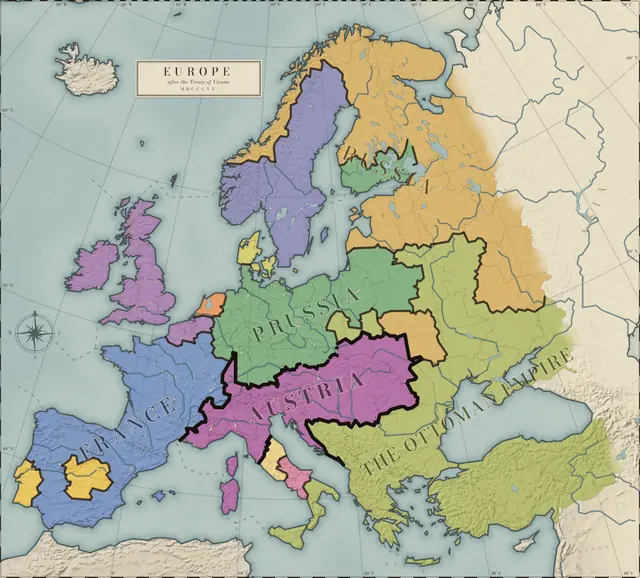
    Map of Europe in 1829, from this game: the territories of the twelve powers, wars hatched in the enemy’s colour.
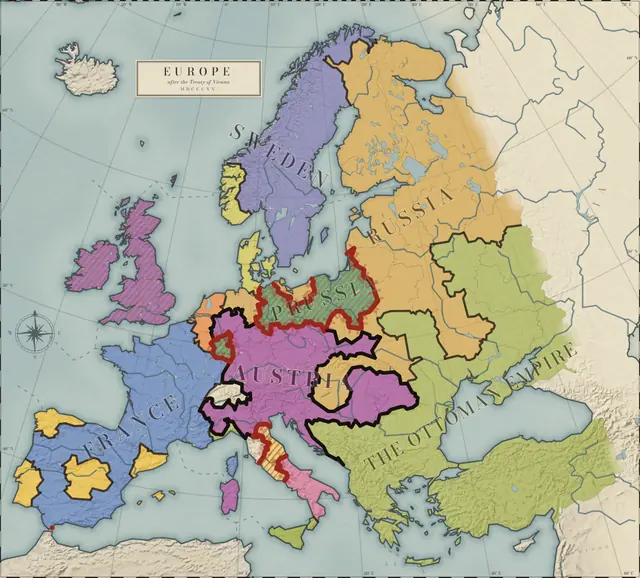
  3. 1830turn 28

    Three days in July

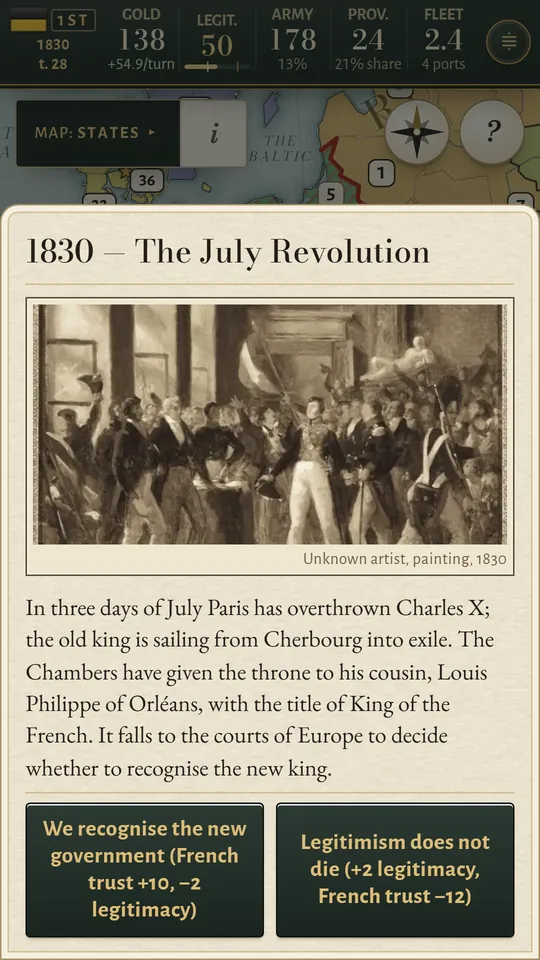
    In three days of July Paris has overthrown Charles X. … It falls to the courts of Europe to decide whether to recognise the new king.

    Recognise him, and French trust rises by 10 while legitimacy dips by 2. Refuse, and it goes the other way.

    Map of Europe in 1830, from this game: the territories of the twelve powers, wars hatched in the enemy’s colour.
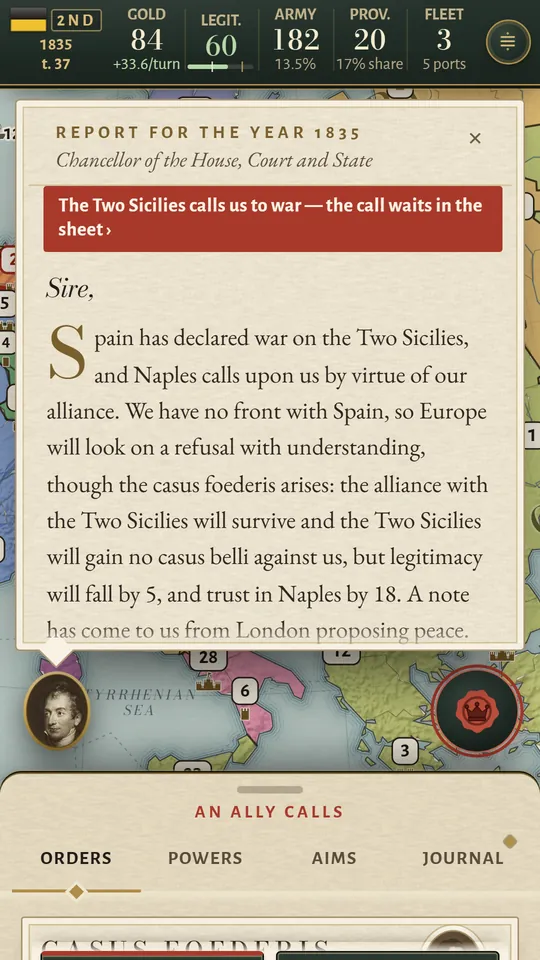
  4. 1835turn 37

    Naples calls

    Spain has declared war on the Two Sicilies, and Naples calls upon us by virtue of our alliance.

    There was no front with Spain, and Europe would have understood a refusal. Austria came all the same.

    Map of Europe in 1835, from this game: the territories of the twelve powers, wars hatched in the enemy’s colour.
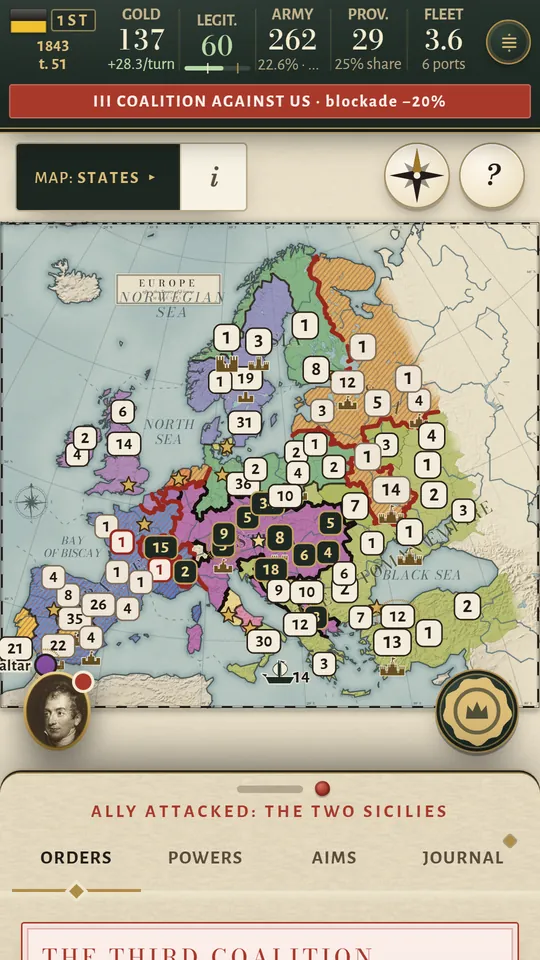
  5. 1843turn 51

    The price of a congress

    The price: 88 gold, renouncing every casus belli, and the return of 4 conquered provinces — the freshest first.

    The third coalition stood against Austria, with a blockade on its revenue. Vienna called a congress and paid.

    Map of Europe in 1843, from this game: the territories of the twelve powers, wars hatched in the enemy’s colour.
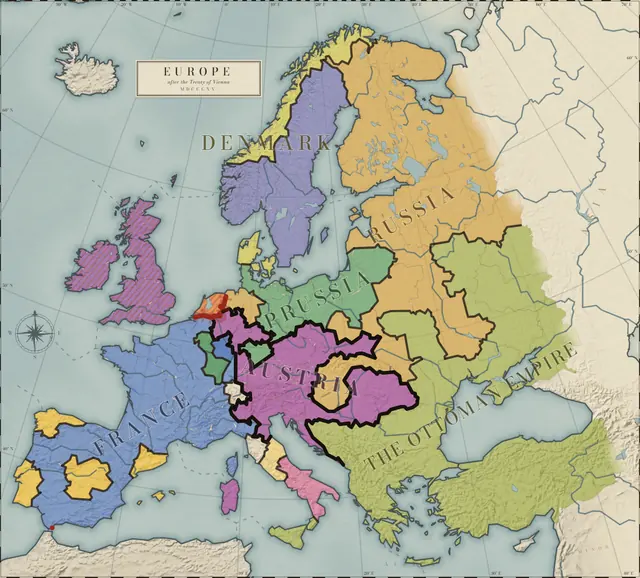
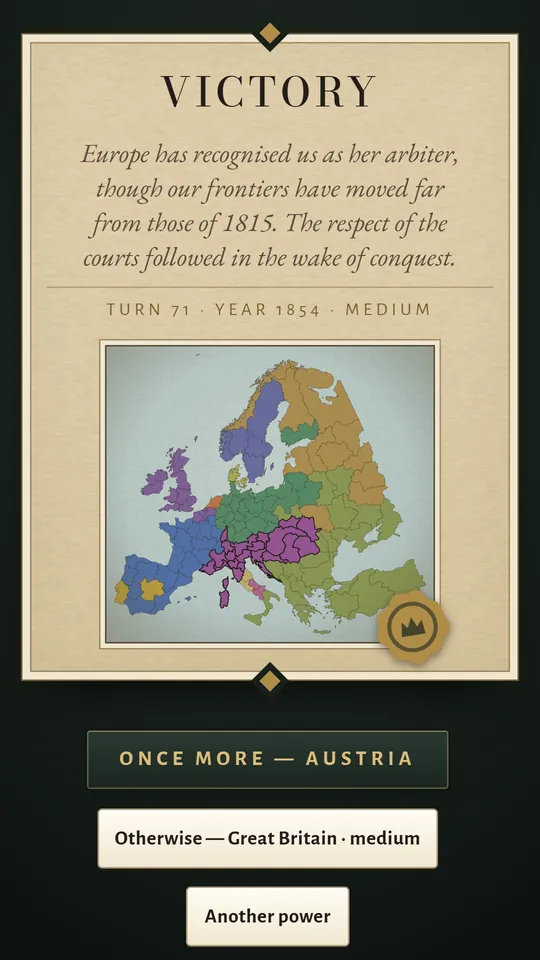
  6. 1854turn 71

    The verdict

    Europe has recognised us as her arbiter, though our frontiers have moved far from those of 1815.

    Victory, seventeen years before the last congress. Another game would have ended otherwise.

    Map of Europe in 1854, from this game: the territories of the twelve powers, wars hatched in the enemy’s colour.

In your game, none of this has to happen.

We have no eternal allies, and we have no perpetual enemies.

Lord Palmerston, House of Commons, 1 March 1848

The game on screen

On a computer: the chancellor’s study

Computer screen of the game: a map of Europe on a dark green desk; in front, the Casus Foederis card with the price of honouring and of refusing Austria’s call.
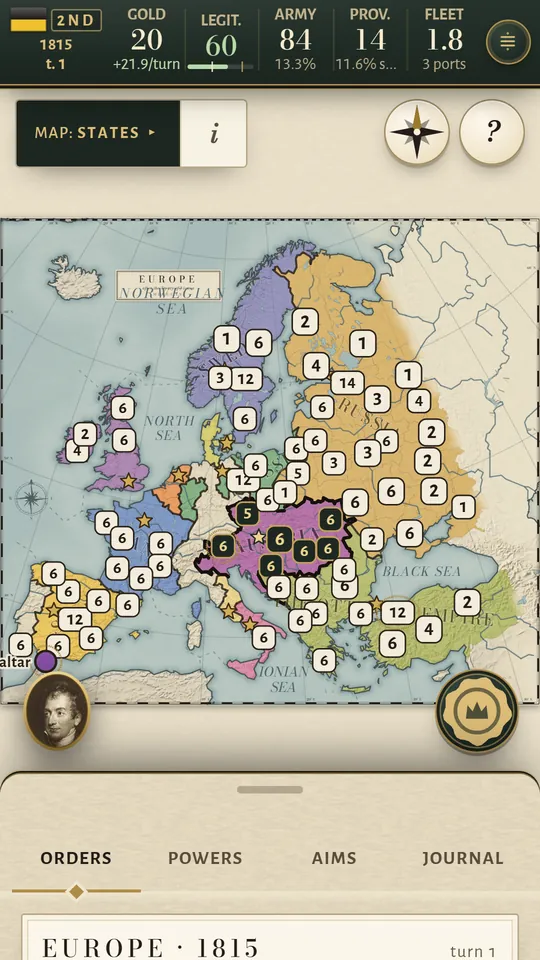
The Steam edition, in development. A screen from the current build: Prussia in 1822, and Austria calls.

On a phone

Where to play

No ads, no subscriptions, no account.

For press and creators

Writing about the game or recording it? Write to us. We will send what you need: facts, images and, once the game is out, a code for the full version.

contact@casusfoederis.comPress kit (English)